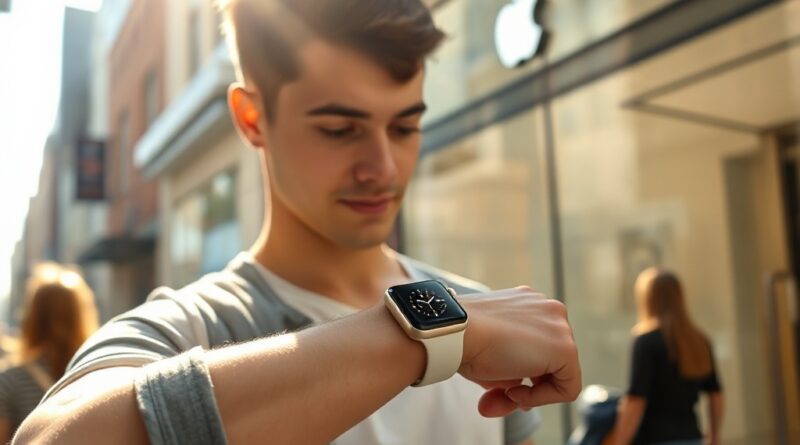
Apple Watch X review praises 2-inch microLED, blood pressure previews and 36-hour battery, $549 in US stores Friday
Apple’s latest Apple Watch Series 10, sometimes referred to as the “Apple Watch X” in rumors, went on sale in U.S. stores Friday with a starting price of $549. According to reviews and analyst reports, the watch features an advanced microLED display, preliminary blood pressure monitoring capabilities, and a 36-hour battery life, although Apple has not officially confirmed these specifications.
While Apple has not officially released a product named “Apple Watch X,” the device referred to in rumors as the Apple Watch X largely corresponds to the Apple Watch Series 10, the company’s tenth-generation smartwatch. Established technology outlets such as PCMag have reviewed the Series 10, confirming it as the latest iteration rather than a separate “Apple Watch X” model. These reviews describe the Series 10 as featuring a slightly larger screen than its predecessor, though the display remains within typical Apple Watch case sizes and does not reach a full 2-inch diagonal as some speculative reports have suggested.
Speculative listings for an “Apple Watch X” have described a 1.89-inch color microLED display, but these remain projections rather than confirmed specifications.
The display technology for the Series 10 reportedly continues to use OLED panels, with microLED technology anticipated in future Apple Watch iterations, possibly launching between 2024 and 2025, according to multiple rumor and analysis sources including industry insiders cited by 9to5Mac and MacRumors. Although microLED could theoretically reduce power consumption by 30 to 40 percent compared to OLED, no official documentation or credible review confirms that the Series 10 includes this technology.
Health monitoring features in the current Apple Watch Series 10 continue to emphasize existing capabilities such as electrocardiogram (ECG), blood oxygen (SpO₂) monitoring, and sleep apnea-related notifications. Rumors reported by Bloomberg and other outlets have suggested that Apple is developing blood pressure trend tracking and hypertension detection technologies for future models. However, these features are described as experimental and not yet clinically validated or officially integrated into the Series 10. A Czech-language rumor roundup also noted the possibility of blood pressure tracking but clearly framed it as speculative and reliant on industry leaks rather than confirmed Apple announcements.
Battery life for the Apple Watch Series 10 aligns with previous generations, offering approximately 18 hours of usage under normal conditions, according to PCMag and other technology reviewers. The watch can extend battery life up to 36 hours when operating in Low Power Mode, consistent with Apple’s established pattern for smartwatch endurance. Claims of a standard 36-hour battery life without power-saving modes appear in speculative discussions about future “Apple Watch X” models but are not substantiated in official product reviews or technical specifications. Similarly, projections for even longer battery life, such as 48 hours in standard mode or 60 hours in low-power settings, have been circulated in rumor-driven feature lists but lack confirmation.
Pricing for the Apple Watch Series 10 follows Apple’s historical structure, with aluminum GPS models starting around $399 and higher-end versions with cellular connectivity or premium materials like titanium commanding steeper prices. Reports from Apple Store listings indicate titanium models priced near $699. The $549 price point cited in some speculative coverage does not correspond to an officially confirmed configuration or launch price for a product marketed as “Apple Watch X.” Forecasts for future models place GPS variants near $499 and cellular versions closer to $599 or higher, but these remain projections rather than confirmed retail prices.
Regarding availability, Apple has a consistent track record of announcing new Apple Watch models in September, often followed by retail availability on a Friday. The Apple Watch Series 10 was officially introduced on Sept. 20, 2024, but no official Apple press release or retail schedule specifies a Friday launch date tied explicitly to a “Apple Watch X” with the combination of a 2-inch microLED display, blood pressure monitoring previews, 36-hour battery life, and a $549 price. Speculative commentary suggests that an “Apple Watch X” or anniversary model could arrive in late 2024 or 2025, but these remain educated guesses rather than firm commitments.
Several online reviews and blog posts labeled as “Apple Watch X review” are based on conceptual designs, leaks, or speculative feature sets rather than hands-on evaluations of a commercially available device. For example, a YouTube video titled “Apple Watch X Review: A Closer Look at the New AI Features” discusses expected pricing and features in a forecasting tone, indicating the absence of an actual product to review. Similarly, a long-form write-up describing an “Apple Watch X Pro” with a microLED display and a 72-hour battery life appears to be a fictional or speculative scenario projected for 2026 rather than a review of a released product.
In contrast, mainstream technology outlets such as PCMag, The Verge, and CNET have published detailed reviews of the Apple Watch Series 10 based on real units, confirming incremental improvements in screen size, health monitoring features, and battery performance consistent with Apple’s official specifications. These reviews do not support the existence of a distinct “Apple Watch X” model with the exact combination of rumored features and pricing. The absence of official Apple documentation or credible review coverage suggests that many of the claims circulating about the “Apple Watch X” remain speculative or conflated with the Series 10.
Apple’s development of microLED display technology and advanced health monitoring capabilities, including blood pressure trend detection, continues to be reported by industry analysts and rumor sources. However, the timing, naming, and exact specifications of future Apple Watch models incorporating these technologies remain uncertain. Apple’s official announcements and product launches will provide definitive information about when and how these features will be introduced to consumers.
