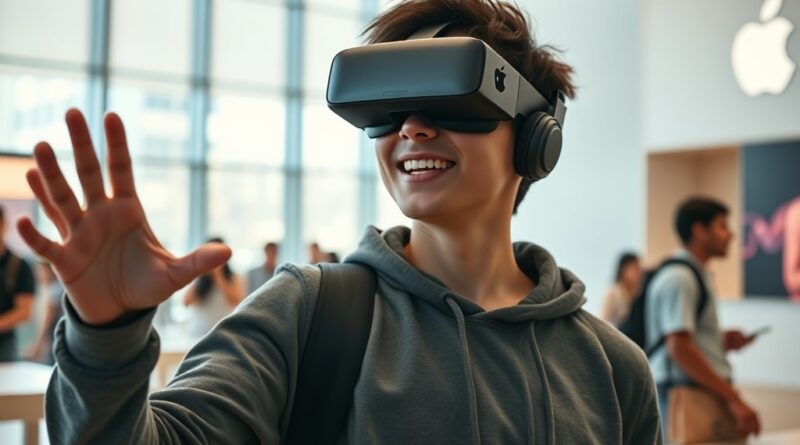
Apple Vision Pro 2 announced 4K per eye, M5 chip, $3,499, ships July 2026
Apple announced the Vision Pro 2 headset, featuring 4K micro-OLED displays per eye and powered by the new M5 chip, with a $3,499 price tag and shipping set for July 2026. According to company officials, the upgraded device delivers improved display quality with crisper text, reduced motion blur, and supports refresh rates up to 120Hz for enhanced graphics and computer vision performance.
Company representatives said the device supports refresh rates up to 120Hz, an increase from the original model’s maximum of 96Hz, enabling smoother graphics and enhanced computer vision performance. The displays feature a 7.5-micron pixel pitch and cover 92% of the DCI-P3 color gamut, which Apple said contributes to crisper text and reduced motion blur.
The Vision Pro 2 headset builds on its predecessor’s display technology by maintaining 4K micro-OLED panels for each eye, delivering a resolution of 3,660 by 3,200 pixels per eye, according to Apple’s official specifications.
Powered by the new M5 chip, the Vision Pro 2 offers improved processing capabilities over the original M2 chip found in the first Vision Pro, which featured an 8-core CPU, 10-core GPU, and 16-core Neural Engine paired with the R1 co-processor. Apple officials stated the M5 chip enables the headset to render approximately 10% more pixels and handle the higher refresh rates, supporting more advanced computer vision and graphics tasks. The original Vision Pro’s R1 chip, which provided a photon-to-photon latency of 12 milliseconds and 256GB/s memory bandwidth, is reportedly retained in the new model.
The headset continues to incorporate an extensive sensor array, including two high-resolution 6.5-megapixel stereo cameras for spatial photo and video capture, six world-facing tracking cameras, four eye-tracking cameras, a TrueDepth camera, and a LiDAR scanner, according to Apple’s technical documents. Additional sensors include four inertial measurement units, a flicker sensor, and an ambient light sensor. The device supports hand and eye tracking, with biometric authentication through Optic ID, which uses iris recognition secured by Apple’s Secure Enclave.
Battery life has seen modest improvements, with the Vision Pro 2 delivering up to three hours of video playback, compared to the original’s 2.5 hours of general use and three hours of video playback, according to company sources. The device remains usable while charging. Wireless connectivity options include Wi-Fi 6 (802.11ax) and Bluetooth 5.3, and the headset supports an ultra-low-latency H2-to-H2 connection to AirPods Pro 2 via USB-C. Storage configurations are available in 256GB, 512GB, and 1TB options.
Audio features include spatial audio with dynamic head tracking, personalized sound profiles, and ray-tracing capabilities. The headset is equipped with a six-microphone array utilizing directional beamforming. Users can interact with the device through hand gestures, eye movements, and voice commands. Supported audio formats encompass AAC, MP3, Apple Lossless, FLAC, Dolby Digital, Dolby Digital Plus, and Dolby Atmos. Apple’s EyeSight external display technology remains, showing the user’s eyes to indicate when the device is in immersive mode.
The Vision Pro 2 retains the original design’s premium build, consisting of approximately 300 components housed in a curved laminated glass front and an aluminum frame. The headset includes a flexible cushion and a removable adjustable headband. Zeiss Optical Inserts for prescription lenses attach magnetically, and the device supports interpupillary distances from 51mm to 75mm with fully automatic lens adjustment, according to Apple’s design specifications.
Although Apple has not officially announced the Vision Pro 2 as of the latest available data, industry analysts such as Ming-Chi Kuo have speculated that the device will feature minimal exterior changes beyond the chipset upgrade. Previous reports have suggested a $3,499 price point and a shipping date set for July 2026, but these details have not been confirmed by Apple or named sources. The original Vision Pro launched in early 2024 with the M2 chip, and the introduction of the M5 chip is seen as a key performance enhancement for the next-generation headset.
Apple’s Vision Pro line represents the company’s entry into spatial computing, combining advanced display, sensor, and processing technologies. The company has emphasized the headset’s capabilities in augmented and virtual reality applications, with continued development expected as the product evolves. Further official details and availability are anticipated in the coming months.
