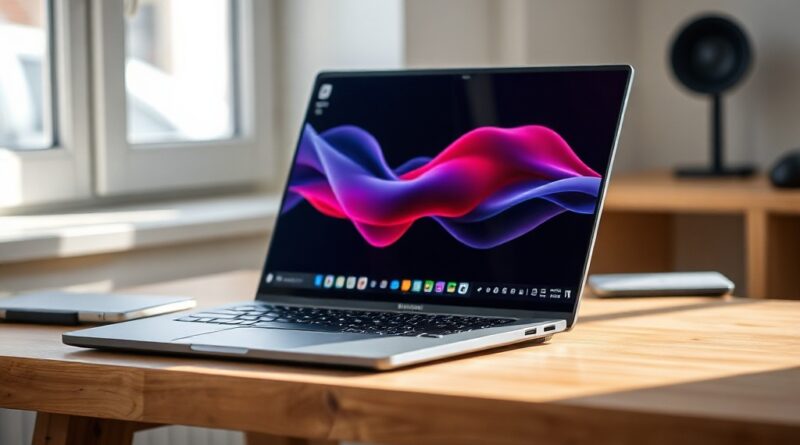
Dell XPS 14 2026 review finds RTX 5070 graphics and OLED option starting at $1,699 in the US and EU
Dell launched its redesigned XPS 14-inch Premium Lightweight Laptop with Intel Core Ultra processors in the U.S. and Europe, starting at $1,699, with availability beginning February 19, 2026. According to Tom’s Hardware and other reviews, the 2026 XPS 14 features RTX 5070 graphics and an OLED display option, highlighting a thinner design and updated internals.
The 2026 Dell XPS 14 model, identified as DA14260, is positioned as a premium redesign centered on Intel’s Panther Lake-generation Core Ultra processors, according to multiple reviews and Dell’s official U.S. product page. The laptop is marketed as the XPS 14-inch Premium Lightweight Laptop with Intel Core Ultra, with configurations beginning at $1,699.99 in the United States and availability starting February 19, 2026, as reported by Tom’s Hardware. Pricing varies by configuration and market, with Engadget citing a starting price of $1,450 for the lowest-end model and up to $2,250 for the highest-end configuration on Dell’s site. A U.K.-based YouTube review noted a base price of £1,599 and a top configuration near £2,100.
Tom’s Hardware tested a configuration with the Core Ultra X7, 32GB RAM, a 1TB SSD, and the 2.8K OLED display.
Contrary to initial impressions of Nvidia RTX 5070 graphics, the 2026 XPS 14 does not include discrete Nvidia GPUs. Tom’s Hardware and Engadget confirm that the laptop relies on integrated Intel graphics, specifically Intel’s Arc B390 GPU in the higher-end models. The YouTube review also corroborates this, noting the top-tier configuration pairs the Intel Core Ultra X7 processor with Intel Arc B390 integrated graphics, with no discrete graphics card option available.
Display options include a base 1920 x 1200 IPS panel and an upper-tier 2880 x 1800 OLED touchscreen. Tom’s Hardware and Engadget describe the OLED panel as a 2.8K touchscreen reserved for premium configurations, while a Reddit post details the OLED display as glossy, touchscreen-enabled, supporting 500 nits brightness, 100% DCI-P3 color gamut, and a refresh rate ranging from 20 to 120 Hz. The YouTube review confirms these options, emphasizing the OLED screen as a high-end upgrade over the base LCD.
Performance benchmarks indicate a significant gap between base and high-end configurations. Engadget reported that the Core Ultra X7 model achieved 130 frames per second in the game Arc Raiders at 1080p medium settings using XeSS upscaling and frame generation. The YouTube review found the X7 model approximately 8% faster in single-core and nearly 50% faster in multi-core benchmarks compared to lower-tier models, with the Arc B390 GPU delivering about 2.5 times the graphics performance of the entry-level integrated graphics.
Battery life varies across configurations. Tom’s Hardware recorded 20 hours and 41 minutes of mixed-use battery life at 150 nits on one tested model, while a second configuration lasted 12 hours and 23 minutes under similar conditions. Engadget cited Dell engineers acknowledging a minor early production typing issue now resolved in current shipments. The YouTube review referenced Dell’s claim of up to 31 hours of local video playback, noting the OLED model’s battery life is expected to be somewhat lower. In a YouTube streaming test at 50% brightness, the Core Ultra X7 OLED configuration lasted over 13.5 hours.
Design changes emphasize portability and a slim profile. The YouTube review identifies the XPS 14 as Dell’s thinnest XPS laptop to date, measuring 14.6 millimeters thick and more than 200 grams lighter than the previous generation. Connectivity includes three Thunderbolt 4 USB-C ports, Wi-Fi 7, Bluetooth 6, and a combo audio jack, with no HDMI port or SD card reader, according to Engadget and the YouTube review. The design reflects a minimalist approach focused on premium materials and portability.
The 2026 XPS 14 represents a significant update to Dell’s XPS line, moving away from discrete Nvidia graphics in favor of Intel’s integrated solutions and offering an OLED display as a premium option. The laptop’s launch aligns with Intel’s Panther Lake processor rollout and reflects Dell’s strategy to deliver a thinner, lighter, and more efficient 14-inch premium laptop for the U.S. and European markets.
