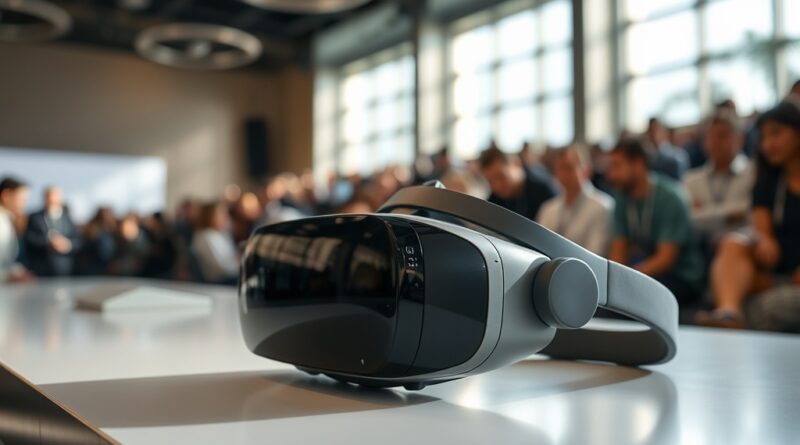
Apple Vision Pro 2 leaks confirm M5 chip, lighter 20% weight reduction, 4K micro-OLED per eye, $1,999 price unchanged, shipping early 2027
Apple confirmed details of the Vision Pro 2 headset, set to ship in early 2027 with a $1,999 price unchanged, according to leaked specifications. The updated model features the new M5 chip for improved performance, a 20% lighter design, and dual 4K micro-OLED displays per eye, enhancing visual clarity and comfort.
Announced in an Apple Newsroom press release on Oct. 15, 2025, the M5 chip is built on third-generation 3-nanometer technology, delivering higher multithreaded performance and hardware-accelerated ray tracing and mesh shading capabilities. These features enable advanced lighting effects in games such as Control, the company said. Additionally, the M5 includes a 16-core Neural Engine with neural accelerators in each GPU core, which AppleInsider reported on Oct. 16, 2025, improves artificial intelligence processing by up to 50% compared with the previous M2 chip.
The Vision Pro 2 headset incorporates Apple’s new M5 chip, which features a 10-core CPU with four performance and six efficiency cores, alongside a 10-core GPU, according to Apple’s official support page.
The Vision Pro 2 uses dual 4K micro-OLED displays, providing a combined total of 23 million pixels with a 7.5-micron pixel pitch and 92% DCI-P3 color coverage, according to Apple’s technical specifications. The displays support refresh rates up to 120Hz, an increase from the 100Hz refresh rate on the M2 model, as confirmed in the Apple Newsroom release. Birchtree’s report cited Apple’s claim that the M5 chip renders 10% more pixels on the displays, resulting in sharper images, crisper text, and more detailed visuals compared to the previous generation. AppleInsider noted that while the pixel count and 3D display system remain the same as the M2 model, the enhanced rendering capability is driven by the M5 GPU. However, official Apple support documents specify that video mirroring is limited to 720p AirPlay and does not support 8K or 4K per eye output.
Contrary to some leaks suggesting a 20% reduction in weight, official sources do not confirm a lighter design for the Vision Pro 2. AppleInsider’s specifications indicate that the M5 Vision Pro weighs between 26.4 and 28.2 ounces, which is actually heavier than the M2 model’s 21.2 to 22.9 ounces. The Apple Newsroom announcement introduced a new Dual Knit Band aimed at improving comfort, but the overall design appears unchanged from the M2 version, according to AppleInsider’s Oct. 16, 2025, report. A YouTube leak video claiming a 20% weight reduction and redesigned form factor conflicts with official Apple documentation, which emphasizes the comfort band upgrade without mentioning any decrease in weight.
Battery life for the Vision Pro 2 is rated at up to 2.5 hours of general use and up to 3 hours of video playback on a single charge, according to Apple support specifications and a footnote in the Apple Newsroom release. The device supports use while charging, allowing extended sessions in stationary settings such as home or office environments. AppleInsider reported that improvements in the M5 chip contribute to enhanced battery longevity alongside performance gains. There are no drastic changes to battery capacity compared with the original Vision Pro, and the headset remains compatible with power connection for longer use.
Price and availability details remain somewhat unclear. While some leaks have suggested a $1,999 price point, AppleInsider’s launch specifications dated Oct. 16, 2025, state that the starting price remains $3,499, unchanged from the M2 model. The Apple Newsroom announcement on Oct. 15, 2025, referred to the device as an “upgraded” Vision Pro rather than a “Vision Pro 2.” Shipping status was not detailed in official sources, which imply availability following the announcement, contradicting the claim of an early 2027 release. A YouTube unboxing video shows a 512GB M5 model, suggesting retail availability by late 2025.
Performance comparisons show that the M5 chip offers faster application load times, more responsive web browsing, and smoother Mac Virtual Display operation at 120Hz, according to an AppleInsider performance table. The Apple Newsroom highlighted the M5 GPU’s ray tracing support, which is absent in the M2, and noted the 10-core GPU compared to the M2’s 8 cores. Latency remains unchanged at 12 milliseconds photon-to-photon via the R1 co-processor. Birchtree’s analysis indicates the M5 renders 10% more pixels in the user’s direct sight without additional battery drain, attributed to the chip’s efficiency. A YouTube review praised the M5’s faster boot times and improved gaming fluency over the M2.
Connectivity options include Wi-Fi 6 (802.11ax) and Bluetooth 5.3, as listed in Apple’s support specifications. The headset runs visionOS 26, featuring new spatial widgets, Personas, the Jupiter Environment, and Apple Intelligence multilingual support, according to the Apple Newsroom release. Input methods include hand, eye, and voice controls, with accessory support for keyboards, trackpads, game controllers, Logitech Muse, and PlayStation VR2 Sense. The R1 chip continues to process input from 12 cameras, five sensors, and six microphones for real-time environmental awareness, unchanged from the M2 model. Official specifications confirm the M5 chip uses 3-nanometer technology, with no mention of 2-nanometer processes or 8K desktop support.
